One of the most common misunderstandings we hear from new customers is surprisingly simple.
"Does black steel pipe mean it's painted black?"
A few years ago, a customer from the Middle East asked us exactly that question. They were sourcing steel pipes for a fire protection project and had quotations from several suppliers. Some described the product as Black Steel Pipe, others called it Black Carbon Steel Pipe, while a few even listed it as Mild Steel Pipe.
To someone buying steel pipes every day, those names might seem interchangeable.
They aren't.
After supplying steel pipes to customers in construction, mechanical manufacturing, oil & gas and industrial projects for many years, we've learned that understanding what a Black Steel Pipe really is can save buyers a lot of unnecessary confusion-and sometimes a lot of money.
Black Steel Pipe Isn't Black Because of Paint
The first thing worth understanding is where the name comes from.
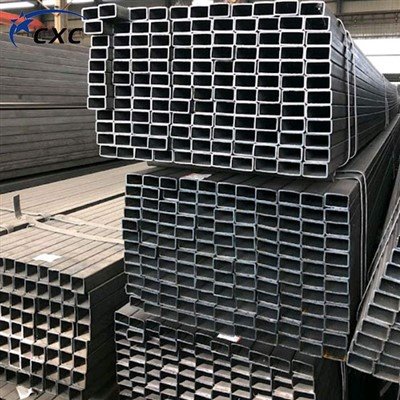
A Black Steel Pipe gets its dark appearance from the iron oxide layer that naturally forms during the hot rolling or manufacturing process. Unlike Galvanized Steel Pipe, it doesn't receive a zinc coating after production.
In other words, the black surface isn't an extra treatment.
It's simply the original surface left after manufacturing.
Many first-time buyers assume that black steel pipes are unfinished products waiting to be painted.
Actually, for many industrial applications, that original surface is exactly what customers need.
Depending on the project, the pipe may later be painted, powder coated, wrapped with anti-corrosion coatings or installed exactly as supplied.
Manufacturing Looks Simple Until Quality Has to Stay Consistent
People often think manufacturing a Black Carbon Steel Pipe is straightforward.
Steel goes in.
Pipe comes out.
If only it were that simple.
At Wuxi Chengxingchuang Metal Products Co., Ltd., we've found that producing consistent steel pipes has much more to do with process control than with individual machines.
Whether the product is an ERW Black Steel Pipe or a Seamless Black Steel Pipe, every production stage affects the final quality.
Raw material quality determines the foundation.
Forming accuracy influences roundness.
Welding quality affects structural integrity for ERW pipes.
Heat treatment changes mechanical performance.
Finally, dimensional inspection ensures the finished pipe matches the customer's requirements instead of just meeting minimum standards.
Customers rarely see these processes.
But they certainly notice the results when fabrication begins.
Manufacturing Is About More Than Making a Pipe
Several years ago, we worked with a machinery manufacturer that was experiencing unexpected welding issues.
At first, they assumed the welding parameters needed adjustment.
After comparing several production batches, they discovered the real difference wasn't the welding process at all.
It was the consistency of the incoming Black Steel Pipe.
The dimensions technically complied with the specification, but slight variations required operators to constantly adjust fixtures.
Once the pipe quality became more consistent, welding efficiency improved almost immediately.
That project reminded us of something we've seen repeatedly.
Manufacturing steel pipes isn't just about producing a round tube.
It's about producing a material that behaves predictably throughout the customer's production process.
Mechanical Properties Matter More Than Many Buyers Realize
When purchasing Black Steel Pipes, many customers naturally focus on outside diameter, wall thickness and price.
Those are certainly important.
But experienced engineers often ask different questions.
Can the material be welded easily?
Will it maintain strength under pressure?
How will it perform after bending?
Can it withstand long-term mechanical loading?
These questions relate directly to the mechanical properties of the steel.
Depending on the material grade and manufacturing standard, Black Steel Pipe offers good strength, reliable toughness and excellent weldability, making it suitable for a wide variety of industrial applications.
That's one reason why it remains one of the most widely used carbon steel products worldwide.
Where Is Black Steel Pipe Commonly Used?
People sometimes expect a complicated answer.
In reality, the reason Black Steel Pipe Applications are so widespread is quite practical.
It performs well.
It machines easily.
It welds reliably.
And it remains cost-effective for large projects.
- Construction Projects
Structural frameworks, scaffolding, support columns and general steel fabrication continue to rely heavily on Black Carbon Steel Pipe because of its strength and fabrication flexibility.
Many construction contractors later apply protective coatings depending on the working environment.
- Fire Protection Systems
This is probably one of the most familiar applications.
Many commercial buildings use Black Steel Pipe for fire sprinkler systems.
Since these systems remain dry or filled with treated water for long periods, galvanized coating isn't always necessary.
Instead, engineers focus more on pressure performance, welding quality and compliance with project specifications.
- Oil & Gas Industry
Although more demanding environments often require specialized materials, Black Steel Pipe remains widely used in low-pressure transportation systems, supporting structures and various auxiliary pipelines.
Customers in this industry usually pay particular attention to manufacturing standards such as ASTM A53, ASTM A106 and API 5L, depending on the application.
- Machinery Manufacturing
Machine builders appreciate Black Steel Tube for different reasons.
Many mechanical components require cutting, welding, drilling and fabrication before assembly.
Good machinability and reliable weldability often matter more than decorative appearance.
Several of our long-term customers manufacture industrial equipment where the steel pipe eventually becomes part of a much larger machine.
Once painted and assembled, nobody notices the original black surface.
What matters is that the fabrication process runs smoothly.
- Agricultural Equipment
Modern agricultural machinery works in challenging environments.
Frames, supports, hydraulic structures and mechanical assemblies frequently use Carbon Steel Black Pipe because it combines strength with reasonable production cost.
For manufacturers producing equipment in large quantities, processing efficiency often becomes just as important as material cost.
- Black Steel Pipe Doesn't Suit Every Environment
One misunderstanding we'd like to clear up is that Black Steel Pipe can be used everywhere.
It can't.
Because it has no zinc coating, bare black steel is naturally more susceptible to corrosion when exposed to moisture over long periods.
That's why outdoor applications often require additional protection such as painting, epoxy coatings or other anti-corrosion systems.
We occasionally receive inquiries asking whether black steel pipe can replace galvanized pipe in coastal environments.
Our answer is usually another question.
"How will the pipe be protected after installation?"
Understanding the service environment is always more important than simply comparing product names.
- Choosing the Right Black Steel Pipe
Whenever customers ask us which Black Steel Pipe they should buy, we don't immediately recommend a size or material.
Instead, we try to understand the project.
- Will the pipe be welded?
- Will it carry pressure?
- Will it be installed indoors or outdoors?
- Does the project follow ASTM, API or EN standards?
- Will corrosion protection be applied later?
These questions often determine the best solution much more accurately than the drawing itself.
After years of working with customers from different industries, we've found that the most successful projects rarely begin with the lowest quotation.
They begin with a clear understanding of how the pipe will actually be used.
Final Thoughts
Although Black Steel Pipe may appear to be one of the simplest steel products on the market, its performance depends on much more than its dark surface.
Raw material quality, manufacturing consistency, dimensional accuracy and application requirements all influence how well the pipe performs in construction, machinery, fire protection and industrial projects.
At Wuxi Chengxingchuang Metal Products Co., Ltd., we've learned that customers rarely remember which supplier offered the lowest price.
They remember the supplier whose products allowed their projects to move forward without unexpected production problems.
For us, that's what a good Black Steel Pipe Manufacturer should provide-not just qualified steel pipes, but confidence that every shipment will perform exactly as expected when it reaches the customer's workshop.