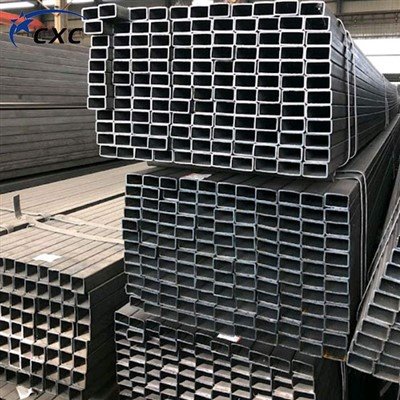
Several years ago, a customer from Southeast Asia visited our factory with a sample of a Black Steel Pipe under his arm.
He placed it on the meeting table and smiled.
"This pipe has worked perfectly for almost fifteen years. We're expanding the project now, but we'd like to understand why this material has lasted so well."
That question stayed with me.
People often ask where Black Steel Pipe is used, but very few ask why it continues to be used, even though newer materials are constantly entering the market.
After working with contractors, equipment manufacturers and EPC companies for many years, we've found the answer isn't complicated.
Black steel pipe isn't popular because it's the newest solution.
It's popular because, when it's selected correctly and installed in the right environment, it delivers exactly what engineers expect-strength, weldability, reliability and reasonable cost.
That's why, despite all the new materials available today, Black Carbon Steel Pipe is still one of the most widely specified products in construction, oil & gas and fire protection projects.
Every Industry Uses the Same Pipe for Different Reasons
One interesting thing we've noticed is that customers from different industries rarely ask the same questions.
Construction companies usually care about fabrication efficiency.
Oil and gas contractors pay much more attention to standards and pressure requirements.
Fire protection engineers focus on long-term system reliability and compliance.
They're buying the same Black Steel Pipe, but they're solving completely different problems.
That's why understanding the application is always more important than simply understanding the product.
Construction Projects Value Practical Performance More Than Fancy Specifications
If you've ever walked onto a construction site, you'll notice something immediately.
Nobody spends much time discussing steel pipe theory.
Everything revolves around progress.
Can it be welded efficiently?
Can it be cut easily?
Can installation stay on schedule?
Those practical concerns explain why Black Steel Pipe remains a common choice for structural steel fabrication, building frameworks, equipment supports, scaffolding systems and utility pipelines.
A contractor we worked with once summed it up perfectly.
"If the pipe helps us finish the project on time without creating extra work, it's the right pipe."
That sentence probably explains the construction industry better than any technical specification.
For these projects, reliable dimensions, good weldability and consistent quality usually matter much more than having the highest mechanical strength on paper.
Structural Fabrication Depends on Consistency
Many customers purchasing Black Steel Tube for structural applications aren't manufacturing the finished product.
They're fabricating it.
That distinction is important.
Fabricators cut.
Drill.
Bend.
Weld.
Assemble.
Every one of those operations depends on the incoming material behaving consistently.
We've seen projects where the steel itself met the required standard, but slight dimensional variation forced workers to repeatedly adjust fixtures and welding positions.
The pipe wasn't defective.
It simply wasn't consistent enough for efficient fabrication.
After years of supplying construction projects, we've come to believe that fabrication efficiency is one of the most overlooked values of a high-quality Carbon Steel Black Pipe.
Oil & Gas Projects Leave Very Little Room for Compromise
The oil and gas industry approaches steel pipes differently.
Here, discussions usually move quickly toward standards.
- ASTM A53?
- ASTM A106?
- API 5L?
That's because these projects often involve pressure, safety and long service life.
A few years ago, an EPC contractor asked us whether they could replace API 5L Black Steel Pipe with a lower-cost alternative for part of a pipeline project.
Instead of answering immediately, we asked where the pipe would actually be installed.
After reviewing the drawings together, it became obvious why the original specification existed.
Changing the material might have reduced procurement costs, but it would also have complicated project approval and inspection.
That conversation reinforced something we've learned many times.
In oil and gas projects, selecting the right standard is often just as important as selecting the right material.
Reliability Is More Valuable Than Saving a Few Dollars
Customers working in energy projects rarely ask for the cheapest quotation.
Instead, they ask questions like:
Can every production batch remain consistent?
Can inspection documents be traced?
Will third-party inspection be available?
Can delivery stay on schedule?
Those questions tell us something important.
For oil and gas projects, the cost of production delays or maintenance is usually much greater than the difference between two quotations.
That's why experienced buyers often evaluate suppliers, not just products.
Fire Protection Systems Have Different Priorities
When discussing Black Steel Pipe for Fire Protection Systems, the conversation changes again.
People sometimes assume galvanized pipe is always the better option.
That's not necessarily true.
Many indoor fire sprinkler systems continue to use Black Steel Pipe because the system design, operating environment and project specifications make it entirely suitable.
One customer responsible for commercial building construction once told us something we still remember.
"Nobody notices the fire sprinkler system until the day it's needed."
He's right.
The success of a fire protection system isn't measured by appearance.
It's measured by whether it performs reliably after years of remaining almost invisible above the ceiling.
That's why engineers pay close attention to manufacturing quality, welding performance and compliance with project standards.
Industrial Plants Continue to Rely on Black Steel Pipe
Outside construction and pipeline projects, Industrial Black Steel Pipe is found almost everywhere.
- Manufacturing plants.
- Power stations.
- Equipment supports.
- Compressed air systems.
- Steam distribution.
- Mechanical fabrication.
In these environments, the pipe often becomes one small part of a much larger production system.
Several equipment manufacturers we've worked with aren't particularly interested in how the pipe looks.
They're interested in whether fabrication proceeds smoothly and whether production can continue without unexpected interruptions.
Again, consistency proves more valuable than appearance.
Choosing the Right Pipe Depends More on the Environment Than the Industry
One question customers occasionally ask is,
"Which Black Steel Pipe is best for construction?"
Or,
"Which one should we use for oil & gas?"
Honestly, those questions are a little too broad.
We've supplied ASTM A53 Black Steel Pipe for industrial buildings.
We've supplied API 5L Black Steel Pipe for energy projects.
We've supplied ASTM A106 Black Steel Pipe for higher-temperature systems.
The project environment determines the selection far more than the industry name itself.
That's why we always encourage customers to discuss operating conditions before discussing specifications.
Temperature.
Pressure.
Corrosion.
Fabrication methods.
Inspection requirements.
Those factors usually provide the answer.
What We've Learned After Years of Working with Different Industries
At Wuxi Chengxingchuang Metal Products Co., Ltd., we've had the opportunity to work with customers from construction companies, machinery manufacturers, EPC contractors and industrial plants across many countries.
Although every project is different, one lesson remains remarkably consistent.
Customers rarely remember the supplier who offered the lowest price.
They remember the supplier whose steel pipes arrived on time, matched the drawings and performed exactly as expected during fabrication.
That's the kind of reliability every industry values, regardless of whether the project is a commercial building, an oil pipeline or a fire protection system.
Final Thoughts
The applications of Black Steel Pipe extend across construction, oil & gas, fire protection and countless industrial sectors because it continues to offer something every manufacturer and contractor appreciates-dependable performance.
Not because it's the most advanced material.
Not because it's the most expensive.
But because, when manufactured consistently and selected appropriately, it performs its job without creating unnecessary problems for the people who rely on it.
After years of supplying Black Carbon Steel Pipes, we've found that's ultimately what customers are looking for.
They're not simply purchasing steel.
They're purchasing confidence that the next stage of their project will move forward exactly as planned.