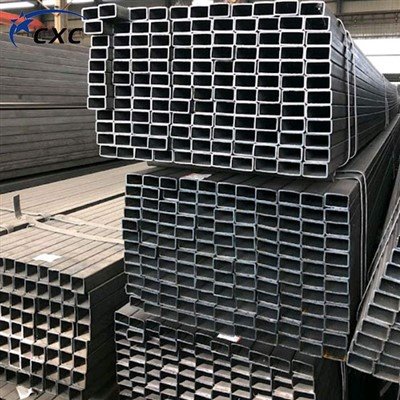
One of the most memorable factory visits we've had wasn't from a purchasing manager-it was from a production engineer.
As we walked through the workshop, he didn't ask about our monthly capacity or delivery time. Instead, he stopped beside the forming line and asked a question that immediately told us he understood steel manufacturing.
"At which stage do you lose consistency?"
It's a question we rarely hear, but it's exactly the right one.
Many buyers believe the quality of a Black Steel Pipe is determined by its material grade. In reality, we've seen projects where two suppliers used the same steel, followed the same ASTM standard and even produced pipes with nearly identical dimensions, yet the finished products performed very differently on the customer's production line.
The reason wasn't the steel.
It was the manufacturing process.
After years of supplying Black Steel Pipes to customers in construction, machinery, fire protection and industrial projects, we've become convinced that understanding how a pipe is made is just as important as understanding its specifications.
Because long before a pipe reaches your warehouse, every manufacturing step has already influenced how it will perform.
Every Good Steel Pipe Starts Long Before the Pipe Exists
When people think about making a steel pipe, they usually imagine a flat steel coil entering one end of a production line and a finished tube coming out the other.
That's technically true.
But the real work starts much earlier.
The quality of the steel coil determines almost everything that follows.
We've occasionally received inquiries from customers asking whether we could produce lower-cost Black Carbon Steel Pipes using different raw materials.
Our answer is always cautious.
Saving a little money on raw material may look attractive on paper, but if the steel itself isn't stable, no amount of precision equipment can completely compensate for it later.
That's why we consider raw material selection the first quality inspection-not the last.
Forming the Pipe Is About Precision, Not Speed
Once the steel coil enters the production line, it gradually passes through a series of forming rollers.
At first glance, the process looks surprisingly smooth.
The flat strip slowly curls until both edges meet, preparing the material for welding.
Visitors often assume that modern production lines simply run faster to increase output.
Actually, experienced manufacturers think differently.
Running faster is easy.
Running faster while maintaining dimensional consistency is much harder.
One of our engineers likes to say that the rollers remember every adjustment you make.
A small change in alignment might not create an obvious defect immediately, but after several hundred tons of production, tiny dimensional differences begin to appear.
Those are exactly the kinds of variations customers notice during fabrication.
Welding Is More Than Joining Two Edges
For ERW Black Steel Pipe, electric resistance welding is the heart of the manufacturing process.
From the outside, the weld seam may appear almost invisible after finishing.
That sometimes leads buyers to believe welding isn't particularly important.
In reality, it demands extremely careful control.
Several years ago, a customer manufacturing steel structures reported occasional difficulties during subsequent fabrication.
After reviewing samples from different suppliers, we discovered that the issue wasn't the welding performed in their workshop.
It originated much earlier.
Minor variations during pipe welding had slightly changed the consistency of the finished material.
The pipes still met inspection standards.
But they didn't behave identically during downstream processing.
That experience reinforced something we've learned repeatedly.
Good welding isn't measured only by whether the seam holds together.
It's measured by whether the entire pipe behaves consistently afterward.
Heat Treatment Often Receives Less Attention Than It Deserves
If you ask customers which production step matters most, many will mention welding.
If you ask engineers, the answers become much more interesting.
For many applications, heat treatment quietly influences the final performance of a Black Steel Pipe.
Depending on the production standard and application requirements, heat treatment helps reduce internal stress, improve ductility and stabilize mechanical properties.
Customers rarely visit this part of the production line.
There's not much to see.
No sparks.
No dramatic machinery.
Just controlled temperatures and carefully monitored process parameters.
Yet we've seen more than one machining issue traced back to inconsistent heat treatment rather than dimensional accuracy.
It's one of those manufacturing stages that receives very little attention until something goes wrong.
Sizing Makes the Difference Between a Pipe and a Precision Product
After welding and heat treatment, the pipe still isn't finished.
It must pass through sizing equipment to achieve the required outside diameter, roundness and straightness.
Some buyers assume that if a pipe measures correctly at one point, the job is done.
Unfortunately, production isn't that simple.
A Black Steel Pipe measuring perfectly at one end but varying slightly over its full length can create unexpected problems during fabrication.
We've worked with customers producing automated equipment where even small variations affected fixture alignment and assembly efficiency.
From their perspective, consistent sizing wasn't a luxury.
It was a production requirement.
Inspection Isn't About Finding Problems-It's About Preventing Them
One thing we've gradually changed over the years is how we think about quality inspection.
Many people view inspection as the final step.
We don't.
We see it as the last opportunity to prevent problems from reaching the customer.
Depending on project requirements, Black Steel Pipes may undergo dimensional inspection, weld examination, mechanical testing, hydrostatic testing, chemical composition analysis and surface inspection.
Some customers also request ultrasonic testing or additional documentation before shipment.
The purpose isn't simply to generate certificates.
It's to ensure that the pipe arriving at the customer's factory behaves exactly like the one they approved during sample production.
Consistency matters much more than passing a single inspection.
Manufacturing Doesn't End When the Pipe Leaves the Mill
This might sound unusual, but we've always believed the manufacturing process doesn't truly end until the customer starts processing the material.
A steel pipe that arrives with damaged ends, poor packaging or corrosion after transportation has already lost part of the quality created during production.
That's why packaging, identification and loading deserve more attention than they sometimes receive.
Several export customers have told us that proper packaging reduced handling damage and simplified warehouse management far more than they expected.
Quality isn't only about what happens inside the factory.
It's also about making sure the same quality reaches the customer's workshop.
Why Two Pipes That Meet the Same Standard Can Perform Differently
One question comes up surprisingly often.
"If two suppliers both manufacture ASTM A53 Black Steel Pipe, why doesn't the material behave exactly the same?"
The answer usually isn't hidden in the standard.
It's hidden in process control.
Production speed.
Roller adjustment.
Welding consistency.
Heat treatment.
Sizing accuracy.
Inspection discipline.
Each individual difference may seem small.
Together, they determine whether the finished Black Steel Pipe simply meets the specification-or consistently performs throughout fabrication.
That's something we've learned from years of working with customers in construction, machinery manufacturing and industrial engineering.
Specifications create the minimum requirement.
Manufacturing experience determines how close you stay to that standard every single day.
Final Thoughts
When people talk about Black Steel Pipe Manufacturing, they often focus on machines.
Cold forming.
Welding.
Sizing.
Inspection.
Those processes are certainly important.
But after years of producing and supplying Black Carbon Steel Pipes, we've come to believe that equipment alone doesn't create quality.
Consistency does.
Consistency in raw materials.
Consistency in production parameters.
Consistency between one production batch and the next.
At Wuxi Chengxingchuang Metal Products Co., Ltd., we've found that customers rarely ask detailed questions about manufacturing because they're curious.
They ask because they've already experienced what happens when production isn't properly controlled.
And in industrial manufacturing, that's usually the difference between a steel pipe that simply satisfies the drawing and one that helps customers manufacture reliable products with confidence.